The DEA Just Changed the Rules for EMS. Are You Ready?
The new PPAEMA final rule — effective March 9, 2026 — makes EMS agencies direct DEA registrants for the first time. That means full accountability, stricter documentation, and unannounced inspections. TITAN can help you build a compliant program before the DEA comes knocking.


Compliance by the Numbers
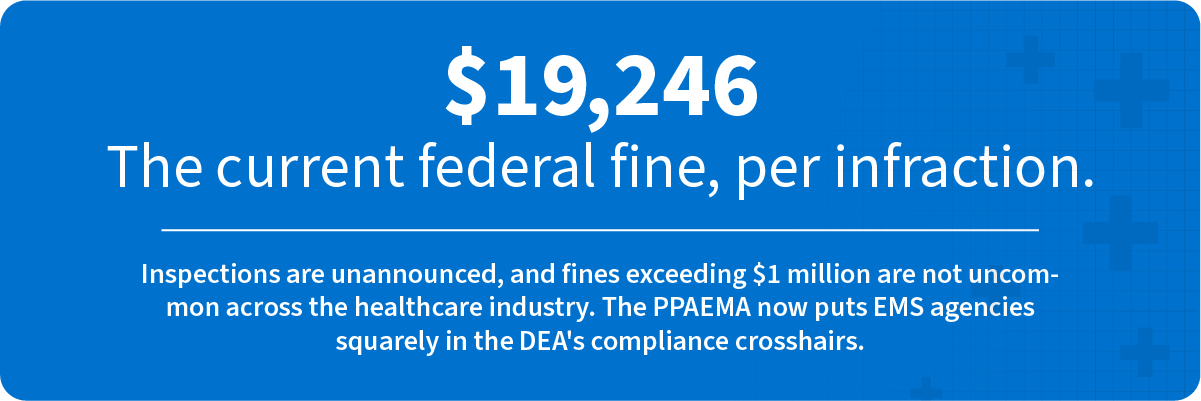
$19,246
Federal fine per infraction
$1M+
Fines are not uncommon
March 2026
PPAEMA final rule effective date
5+
Common DEA violation categories
.webp?width=400&height=86&name=Titan%20Group_%20EMS%20Pillar%20Page%20Graphics_Asset%208%20(1).webp "what changes")
A Landmark Shift in EMS Regulation
For decades, EMS agencies operated under a fragmented regulatory framework — often handling controlled substances under the DEA registration of a hospital, pharmacy, or medical director. That ambiguity allowed gaps in accountability to persist.
The DEA's final rule implementing the Protecting Patient Access to Emergency Medications Act (PPAEMA) ends that ambiguity. As of March 9, 2026, EMS agencies are formally recognized as DEA registrants in their own right — with all the documentation, storage, record-keeping, and audit obligations that come with it.
For EMS leadership, this isn't just a regulatory technicality. It fundamentally changes who is responsible when something goes wrong — and what the DEA expects to find when they show up unannounced.
Records must be "readily retrievable" — meaning accessible immediately during an audit. Agencies must track:
- Receipt & acquisition
- Storage & inventory across vehicles & stations
- Transfers between locations or personnel
- Patient administration & partial waste
- Destruction & final disposition
The DEA holds agencies accountable regardless of size — from a single-unit agency to a regional fleet.
What the PPAEMA Rule Requires
Under the new rule, EMS agencies must demonstrate complete chain-of-custody documentation for every controlled substance — from acquisition through administration or destruction.
.webp?width=649&height=86&name=Titan%20Group_%20EMS%20Pillar%20Page%20Graphics_Asset%207%20(1).webp "reality on the group")
EMS Compliance Challenges
Mobile operations create compliance risks that hospitals don't face. Here are the DEA's top areas of focus:
1. DEA Registration
2. Mobile Storage & Chain of Custody
3. Recordkeeping
4. Drug Diversion Prevention
5. Hospital Restocking
6. Staff Training
7. Waste Documentation
8. DEA Inspections
9. Multi-State Operations
.webp?width=776&height=86&name=Titan%20Group_%20EMS%20Pillar%20Page%20Graphics_Asset%206%20(1).webp "DEA Violations")
What DEA Inspectors Are Looking For
- Lack of Physical Security
- Registration Issues
- Poor Record-Keeping
- Failure to Prevent Diversion
- Incomplete Chain of Custody
.webp?width=673&height=86&name=Titan%20Group_%20EMS%20Pillar%20Page%20Graphics_Asset%205%20(1).webp "TITAN Group")
Your DEA Compliance Partner for EMS
TITAN provides EMS agencies with comprehensive DEA compliance support from former DEA agents and regulatory experts. We guide organizations through DEA registration, compliance assessments, EMS-specific policies and procedures, secure storage implementation, staff training, diversion response, ongoing regulatory compliance, and inspection readiness—helping your agency achieve, maintain, and confidently demonstrate compliance at every stage.
.webp?width=653&height=86&name=Titan%20Group_%20EMS%20Pillar%20Page%20Graphics_Asset%204%20(1).webp "Storage Solutions")
The DEA Requires Locked, Secure Storage. We Make Sure You Have It.
Under the PPAEMA rule, controlled substances must be stored in secure, locked cabinets or safes that cannot be easily removed — at every registered location and in every EMS vehicle. It's one of the most frequently cited violations. TITAN takes the guesswork out by providing end-to-end storage solutions purpose-built for EMS environments.
-
Vehicle Narcotic Safes
Vehicle Narcotic Safes
Tamper-evident, permanently mounted safes designed for ambulances and EMS vehicles. Meets DEA requirements for mobile controlled substance storage with auditable access control.
- Bolted, fixed mounting — cannot be easily removed
- Keyed or electronic access options
- Sized for Schedule II–V medications
- Compatible with electronic logging systems
-
Station Storage Cabinets
Station Storage Cabinets
Heavy-gauge steel cabinets for stationhouse and registered agency locations. Provides the secure, DEA-compliant primary storage your agency needs for bulk inventory management.
- DEA-grade locking mechanisms
- Audit trail-ready access logging
- Scalable across single and multi-station agencies
- Meets 21 CFR Part 1301 physical security standards
-
TITAN Storage Assessment
TITAN Storage Assessment
Not sure if your current cabinets and vehicle safes meet the new PPAEMA standard? TITAN conducts a full physical security assessment — evaluating every storage point across your fleet and stations against DEA requirements.
- On-site or remote assessment options
- Written compliance gap report
- Procurement guidance & vendor recommendations
- Installation support & documentation
Vehicle Narcotic Safes
Tamper-evident, permanently mounted safes designed for ambulances and EMS vehicles. Meets DEA requirements for mobile controlled substance storage with auditable access control.
- Bolted, fixed mounting — cannot be easily removed
- Keyed or electronic access options
- Sized for Schedule II–V medications
- Compatible with electronic logging systems
Station Storage Cabinets
Heavy-gauge steel cabinets for stationhouse and registered agency locations. Provides the secure, DEA-compliant primary storage your agency needs for bulk inventory management.
- DEA-grade locking mechanisms
- Audit trail-ready access logging
- Scalable across single and multi-station agencies
- Meets 21 CFR Part 1301 physical security standards
TITAN Storage Assessment
Not sure if your current cabinets and vehicle safes meet the new PPAEMA standard? TITAN conducts a full physical security assessment — evaluating every storage point across your fleet and stations against DEA requirements.
- On-site or remote assessment options
- Written compliance gap report
- Procurement guidance & vendor recommendations
- Installation support & documentation
.webp?width=558&height=86&name=Titan%20Group_%20EMS%20Pillar%20Page%20Graphics_Asset%201%20(1).webp "Testimonials")
Trusted By Healthcare Organizations Nationwide
“TITAN Group is extremely knowledgeable and advised us as to what the staff and I needed to do to avoid DEA compliance issues now and in the future.”
Vinh Trinh | Pharmacist, RX Care Pharmacy
“
We hired TITAN Group to perform unannounced mock DEA audits to assess our current compliance policies and procedures against DEA requirements. Jack and his team provided us with best practices and enhancements that significantly improved our drug diversion monitoring program, policies, and the skills to perform our own internal investigations.
Jack and his team are always available, responsive, and logical in their advice without being overly complicated in their recommendations. The ongoing support services allow us to reach out whenever we have questions – big or small. TITAN’s interactions with their other clients allows them to provide us with experiences and learn from those – without divulging the other clients’ identity.
”Corporate Director of Compliance Audits | Large Regional Hospital System
“Jack and Titan Group have been a vital part of many DEA related legal matters that I worked on.Jack’s experience and understanding of DEA regulations have been invaluable in helping my clients tackle complex compliance issues and find solutions to their unique challenges.”
Satish Poondi, Esq. | Partner (Legal), Trenk Isabel